Yao, C., Fricker, P. (2021). How to Cool Down Dense Urban Environments? A Discussion on Site-Specific Urban Mitigating Strategies. Journal of Digital Landscape Architecture, 6, 101-111. https://doi:10.14627/537705007.
For more information please contact: chaowen.yao@aalto.fi
Supervisor: pia.fricker@aalto.fi
2020 – 2021
32°C Hellsinki – Outdoor Thermal Comfort Studies and Urban Mitigating Strategies Based on Helsinki Context
Introduction
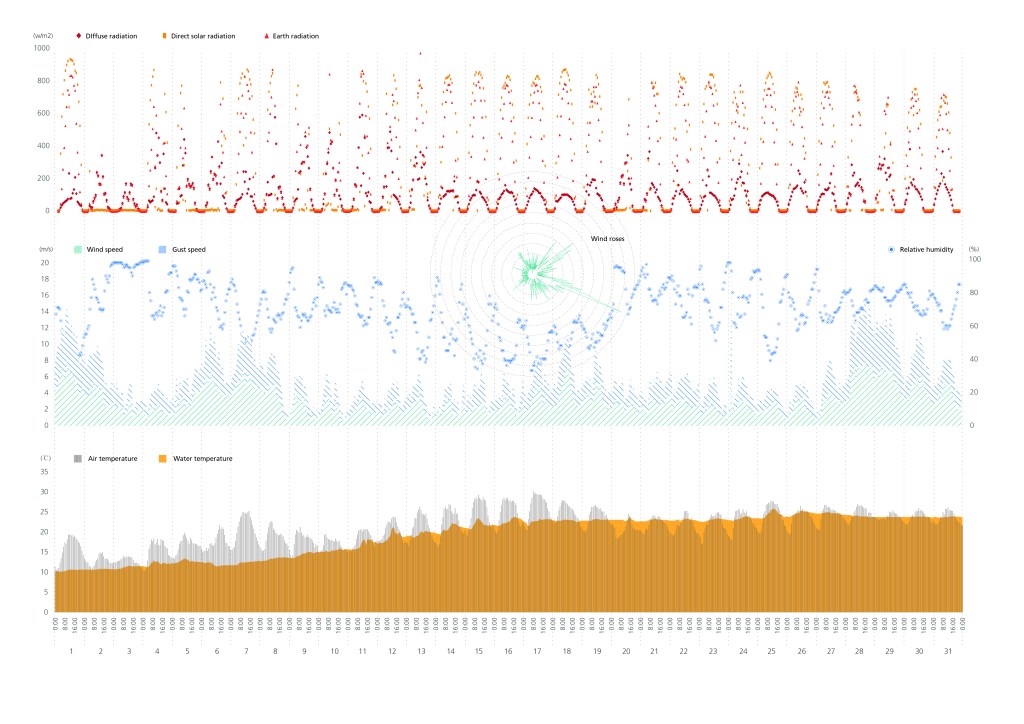
The temperature in Finland has been rising since the last century. In Finland, heatwaves are defined as the days where the maximum temperature exceeds 25 °C (Finnish Meteorological Institute, 2019). According to the Finnish meteorological institute (2019), the heatwaves lasted 25 days in Helsinki in 2018 (Figure 1).
Heatwaves will become more frequent and persistent in the future. Even if the emissions get controlled (RCP=4.5), the maximum and average summer temperature in Helsinki in 2100 will both increase by 3 degrees compared to the present (A. Mäkelä, 2016).
Periods of heatwave lead to increased direct or indirect impacts such as droughts, wildfires, and economic damages on urban and rural areas. Moreover, high temperatures can endanger people’s lives and health, especially in urbanized areas where build-up materials and profiles aggrandize the radiant temperature and decrease air circulation.
Aim
The purpose of this research is to provide the City of Helsinki with a set of sustainable outdoor thermal comfort mitigation solutions under the severe climate in the future. In order to actualize the above objective, the following methodological procedures have been taken:
• Describe the existing meteorology, urban form, and spatial distribution of Helsinki, and select representative area for thermal environment study.
• Compare the characteristics of different thermal environment simulation models. Determine the analysis model and simulate the pilot area.
• Define a set of practical mitigation strategies for the city based on the results of thermal environment simulation.
• Explore the application of research and design results to provide citizens with valuable services. Meanwhile, a feedback platform is established to strengthen the interaction between residents and governors.
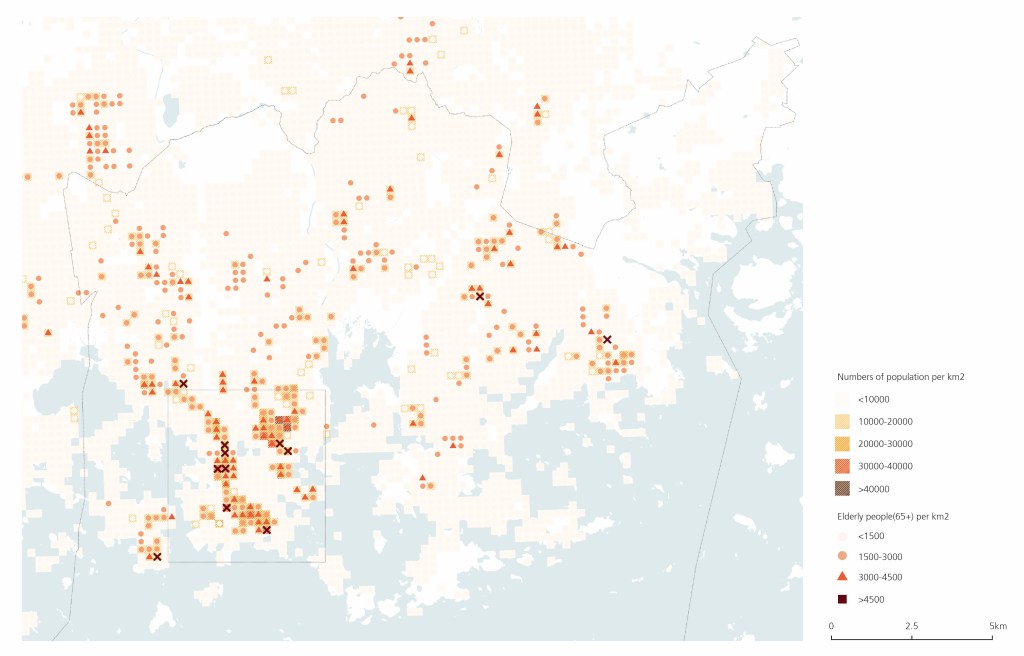
Considering that most populations and the older adults (over 65 years old) are distributed in the city center, which is also in poor green condition and paved with vast impermeable materials, research selects the city center as a pilot area thermal environment study (Figure 2).
The research area sets its focus on the center of Helsinki. Considering the spatial scale and calculation duration, the SOLWEIG was chosen to be the most appropriate for simulating and evaluating the strategy.
Thermal Environment Simulation
Using the SOLWEIG model on the Geographic Information System (GIS) software, the simulation studies the outdoor thermal environment. Simulations are describing the Helsinki thermal environment at different periods. The findings illustrate thermal pressure beginning to appear in the local central area mainly during the morning. The thermal pressure continued until 17:00 when most of the area returned to an acceptable level. At 19:00, the whole area accomplished a thermally comfortable state. In other words, the heatwaves in Helsinki only exists during the daytime.
In general, the open space without shading such as wharves, arterial roads, squares, and artificial parks has very high thermal stress on the human body in summer due to lack of shelter from trees or buildings (Figure 3). Moreover, changing surface materials shows few improvements (≈ 1°C) in human perception in simulation, while tree canopy is a reliable measure to reduce 7 or 8 °C thermal perceptions.

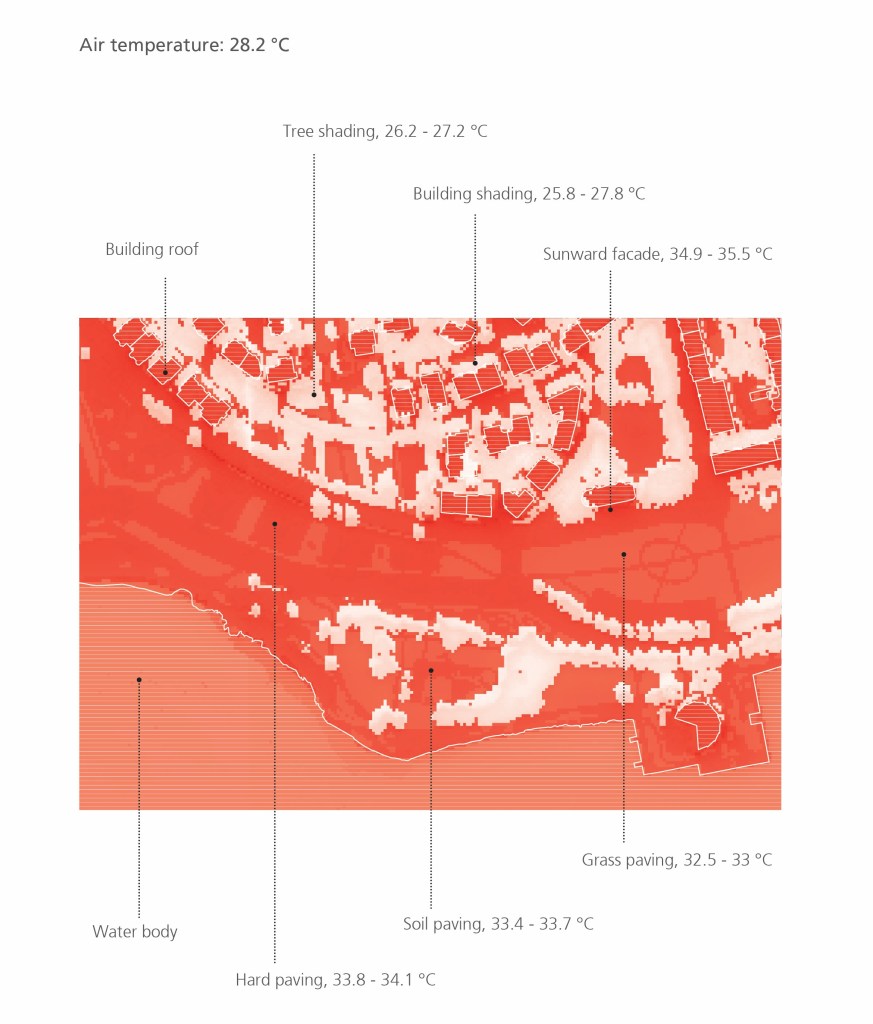
Figure 3. The left diagram displays the methodology of thermal simulation; the right diagram is a section of the simulated thermal environment of Helsinki.
Urban Cooling Strategy
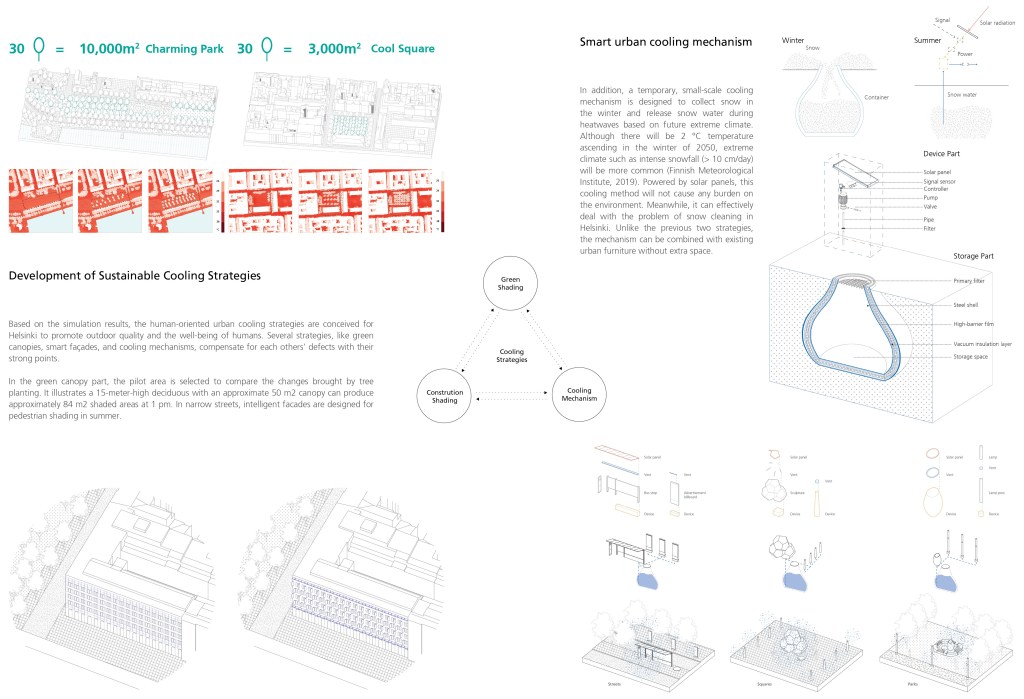
Based on the simulation results, the human-oriented urban cooling strategies are conceived for Helsinki to promote outdoor quality and the well-being of humans (Fugure 4). Several strategies, like green canopies, smart façades, and cooling mechanisms, compensate for each others’ defects with their strong points.
In the green canopy part, the pilot area is selected to compare the changes brought by tree planting. It illustrates a 15-meter-high deciduous with an approximate 50 m2 canopy can produce approximately 84 m2 shaded areas at 1 pm. In narrow streets, intelligent facades are designed for pedestrian shading in summer.
In addition, a temporary, small-scale cooling mechanism is designed to collect snow in the winter and release snow water during heatwaves based on future extreme climate. Although there will be 2 °C temperature ascending in the winter of 2050, extreme climate such as intense snowfall (> 10 cm/day) will be more common (Finnish Meteorological Institute, 2019). Powered by solar panels, this cooling method will not cause any burden on the environment. Meanwhile, it can effectively deal with the problem of snow cleaning in Helsinki. Unlike the previous two strategies, the mechanism can be combined with existing urban furniture without extra space.
Interactive Platform
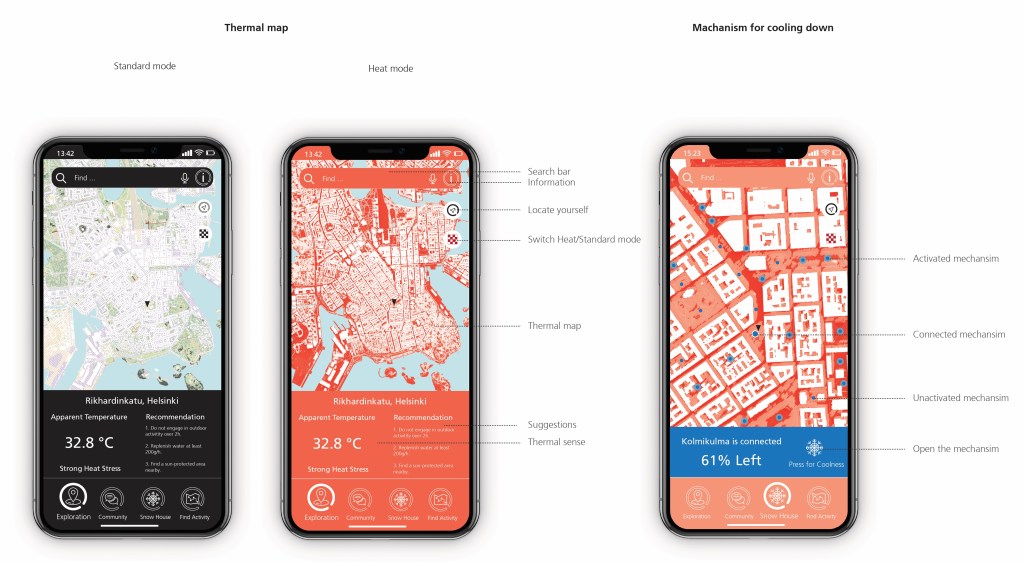
The design of an interactive platform provides citizens with substantial services in summer (Figure 5). As a carrier of thermal environment simulations and designs, the designed web-based platform interacts with residents and urban managers in a more intuitive and visual method. The designed application, as the output of the platform, consists of four primary services: Exploration of the Urban Heat Map, Feedback from Citizens, Outdoor Activity Guidance, and Integration of Snow House Mechanism in the Application.
According to the GPS positions, the application will send the precise heat stress data of their place and provide users with a more suitable and site-specific proposal for outdoor activities. Users can also control the mechanism to cool down nearby areas on this platform (Figure 5). What is more, the application allows the public decision-makers to “listen” to the citizens’ voice in a more focused and site-specific manner, which would prevent authorities from investing in time-intensive research. Instead, concrete measures, such as planting trees, building intelligent facades, and installing cooling mechanisms, could be taken. Through this platform, residents can participate in these actions to ameliorate Helsinki’s thermal environment and sense the city’s improvements. Governors can also selectively intervene in urban space through feedback from users.
Urban Scenario
Combining with the Helsinki Sustainable Development Goals, future urban scenarios have prospected. In the scenario, multiple combinations of urban cooling strategies are implemented according to different functional spaces, transforming Helsinki into the most functional city with implementing sustainable development responsibility locally (Figure 6). Towards this objective, the implemented interventions impact Helsinki and its inhabitants. On the one hand, the design works fill the existing gap in urban services and infrastructure in the forthcoming extreme climate. On the other hand, participating in the thermal environment confrontation will popularize sustainable awareness among urban residents. Moreover, the characteristics of sustainable development and government-resident interaction will make Helsinki the city unique.
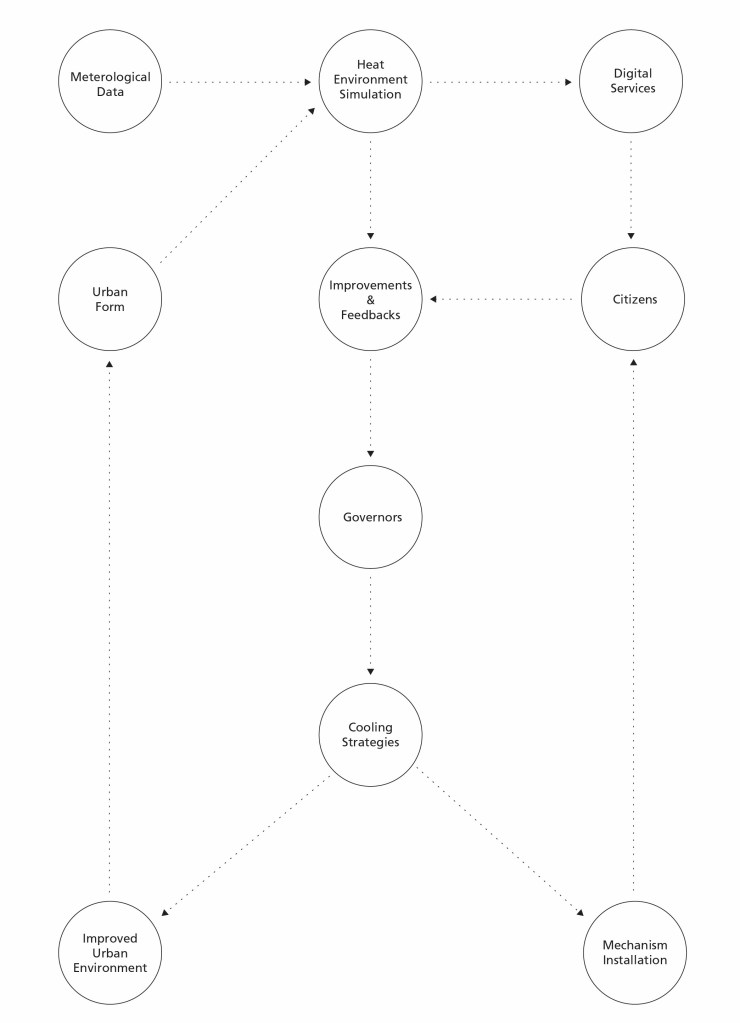
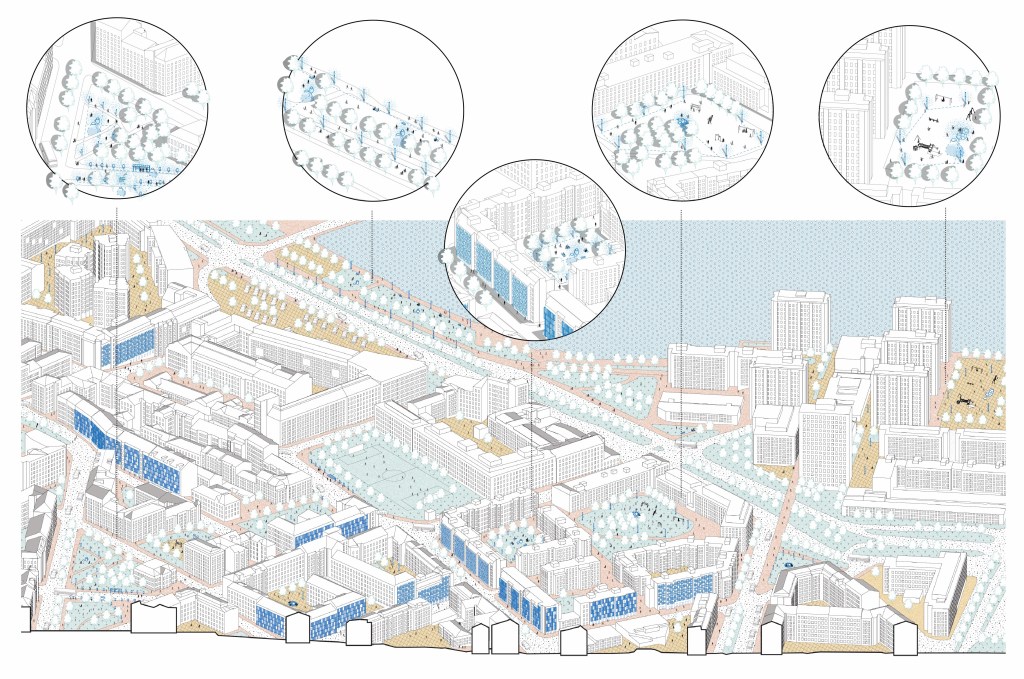
Figure 6. The left diagram displays the system for urban heatwave mitigation; the right diagram displays the urban scenario.
 YAO Chaowen